
America’s Most Dangerous Legal Question: Who Deserves to Die?
This is what happens when a broken system hides behind IQ scores and calls it morality...

THE IQ OF JUSTICE: WHEN THE DEATH PENALTY MEETS A BROKEN HUMAN BRAIN
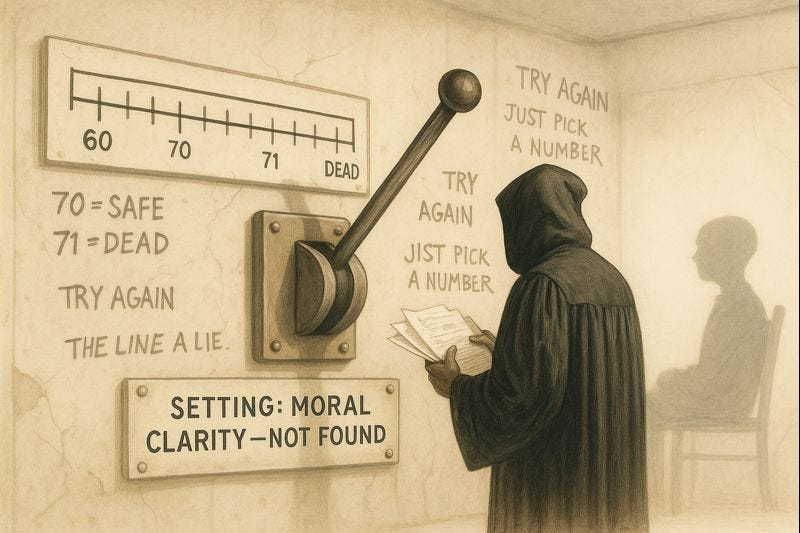
There’s a special kind of madness that happens when America tries to talk about the death penalty. We pretend justice is a vending machine: insert crime, push the button, out pops a righteous sentence. Dirt simple. Orderly. Moral.
Except one of the more recent Supreme Court cases blows that fantasy to smithereens.
Because the question on the table is as grotesque as it is unavoidable:
How many IQ points does it take to be execution-ready in the United States of America?
We’re not talking about geniuses. We’re not even talking about your cousin who thinks Wi-Fi is stored inside the electrical outlets. We’re talking about people with IQ scores in the low 70s. The cognitive neighborhood where moral reasoning sputters like a tractor missing half its spark plugs.
And yet states are standing in front of the Court asking, with a straight face, to treat these individuals like fully formed moral actors, ready to meet the needle.
Grab whatever caffeine you have left. This is the one nobody wants to look at directly.
THE COURT ISN’T DECIDING A CASE — IT’S DECIDING WHO COUNTS AS HUMAN ENOUGH TO KILL
Twenty years ago, SCOTUS said the state can’t execute intellectually disabled people. “Cruel and unusual.” Eighth Amendment. Basic decency. Bravo.
But they didn’t say how to determine who qualifies.
So here we are, decades later, watching states argue that the magic cutoff is IQ 70.
Score 69? Too disabled to kill.
Score 71? Load the syringe.
This isn’t justice.
This is bureaucracy cosplaying as morality.
IQ tests are not divine tablets. They’re flawed, culture-biased, mood-sensitive instruments that swing ten points depending on whether the test-taker got enough sleep or remembered breakfast.
And yet we’re treating them like a cosmic pizza cutter for determining who lives and who dies.
Think about that while you sip your latte. Try not to choke.
THE ISLAND OF THE MISFIT MURDERERS
And here’s where the moral migraine begins to throb.
Say we don’t execute them. What then?
We release them? Into whose neighborhood? Whose train station? Whose daughter’s walk home?
Please.
Some of these folks are impulsive. Some are manipulable. Some have the moral compass of a wet sponge. Put them back into society and you’re basically running a social experiment titled:
“Let’s Hope This Time the Brain Glitches Stay Quiet.”
So maybe we isolate them. Maybe we build a giant reserve in the middle of nowhere and stick every low-IQ murderer in it, let them farm the land and fend for themselves.
Sounds tidy until you imagine it for more than twelve seconds.
You’d create a violent ecosystem run by the impulsive, fueled by the confused, and exploited by the semi-coherent. A criminal ant farm with no exit strategy.
That isn’t justice.
That’s outsourcing danger.
EXECUTING THEM ISN’T JUSTICE EITHER — IT’S STATE-SPONSORED DELUSION
And yet there’s another side of you; yes, you, the angry citizen screaming into the breakfast void that says:
“They took a life. Kill them.”
Except what if they never fully understood the consequence of their actions? What if their brain never installed the update called “moral agency”? What if they’re cognitively stuck in a permanent middle-school fog where impulse outruns reasoning every single time?
Executing someone who can’t truly comprehend death isn’t justice.
It’s extermination with paperwork.
If that line makes you uncomfortable, congratulations, you’re still human.
THE LINE DOESN’T EXIST — AND THAT’S WHAT TERRIFIES EVERYONE
Here’s the hidden truth nobody wants to say out loud:
There is no bright line between responsible and not responsible.
There is no magic number.
There is no safe, clean boundary of morality.
The human brain is a continuum.
The law demands categories.
So we pretend. We force the numbers. We call it justice.
Meanwhile the truth is sitting in the corner screaming:
Some people are too dangerous to release but too impaired to kill.
And our system was not built to handle that contradiction. It wasn’t even built to admit it exists.
So we do what America always does when morality gets messy:
We bury the complexity under buzzwords, tests, and procedures until nobody can see the horror anymore.
THE REAL QUESTION: WHAT DOES SOCIETY OWE TO ITSELF?
Forget party lines. Forget the cheerleaders of punishment and the choir of mercy.
This is about us, the society. The living. The people still trying to walk through this world without being burned, stabbed, beaten, or coerced by someone whose brain never fully turned on.
We owe ourselves safety.
We owe ourselves decency.
We owe ourselves honesty.
And honesty says this:
There are individuals whose cognitive limits make them dangerous forever.
There are individuals whose cognitive limits make them unfit for execution.
And sometimes those two circles overlap.
That overlap is the moral sinkhole we’re standing on right now.
A country with courage would deal with it head-on.
A country with cowardice will keep pretending the numbers tell the truth.
Take a guess which one we’ve been so far.
SO HERE’S THE ONLY REAL HIDDEN TRUTH THAT MATTERS
Justice isn’t a number.
Mercy isn’t a loophole.
The death penalty isn’t a math problem.
If we’re going to keep the power to kill in the hands of the state, we damn well better confront the monstrous gray zone where morality breaks down and the brain betrays the body.
Because somewhere between IQ 69 and IQ 72 lies the most terrifying question in modern justice:
What do you do with a killer who doesn’t fully understand killing?
Until we answer that honestly, everything else is just ritual.
These are difficult questions. One can have a low IQ and still have a moral compass. Even very young children know the difference between right and wrong, good and evil. I don't think IQ is relevant. There are brilliant psychopaths.
The Commandment says “Thou shall not commit murder.” It does not contain exemptions for low IQ people. It does not include a requirement to provide long-term care for low IQ people. That said, I understand the “modern” “compassionate” feelings of some to create a different system of “justice” for low IQ people, but I do not agree with it.
If your choices are:
A) execution,
B) life imprisonment in the nut house with thousands of other criminals who are also retarded (yes that is the word for it),
C) demand their families to care for that person and keep them from killing more people,
or D) release them into society and hope for the best.
Primitive cultures here on Earth (yes they exist today in Africa, the Middle East, Indonesia, and the Amazon) are more pragmatic. I lived in daily direct contact with one in East Africa. They can’t afford to incarcerate dangerous criminals (sane or not) so they don’t; they bury them.
Compassion is a choice ultimately ruled by available resources and alternative choices.
Do we objectively feel sorry for the retarded person. Sure.
Do we feel sorry for the family who had to admit they were unable to control their retarded son? I do.
Do we grieve with the family of the slain victim? We better.
Do we want to protect society from a repeat? We better.
Do we want to pay to put the murderer in a special prison and provide security, some wicked medicines, healthcare, food, clothing, lawyers, recreation, and “community” with other similarly afflicted people?
Are there other choices?