
Bring Back the Damn Civil Service Exam...
The Government Replaced Merit with a Self-Esteem Survey—and You’re Paying for It!

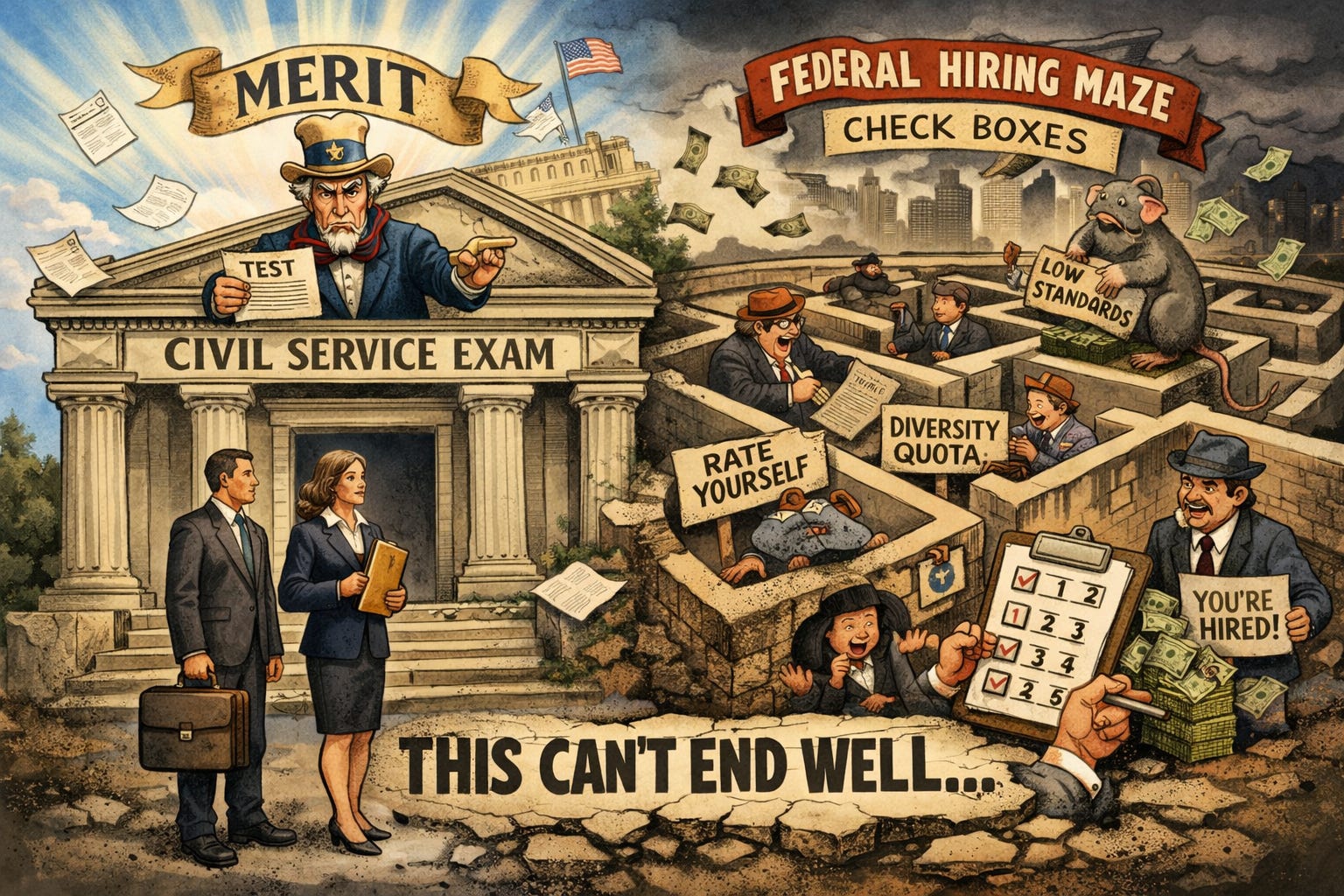
Bring Back the Damn Civil Service Exam
There was a time in this country when if you wanted a federal job, you had to prove you weren’t an idiot.
Radical concept. I know.
You took a Civil Service exam. You passed it. You earned your way in.
Merit.
Not vibes.
Not checkboxes.
Not “rate yourself from 1 to 5 and pinky swear you’re amazing.”
But somewhere along the way, we decided that was too… uncomfortable.
So what did we replace it with?
A glorified self esteem survey.
Picture this.
You are applying for a federal analyst job. You log into USAJobs. You fill out a questionnaire that basically says:
On a scale of 1 to 5, how incredible are you at:
• Critical thinking
• Policy analysis
• Writing
• Leadership
• Breathing
Now tell me something.
If selecting anything less than a 5 gets your application tossed into the digital abyss… what are you clicking?
Exactly.
Five.
Five.
Five.
Five.
Five.
And so does everybody else.
Congratulations. We have just created a system where confidence beats competence.
Don’t pee on my leg and tell me that’s merit based hiring.
We Used to Care About Standards
Back in 1883, after patronage and political crony nonsense got out of control, Congress passed the Pendleton Act. The idea was simple.
Stop handing out government jobs like Halloween candy.
Instead, test people. Rank them. Hire the best.
And for decades, that’s what we did.
In the 1970s, if you wanted into professional federal tracks, you took the PACE exam. Hundreds of thousands did.
Was it perfect?
No.
Nothing designed by humans is.
But it tried to measure something real.
Then came lawsuits.
Then came disparate impact doctrine.
Then came bureaucrats terrified of getting sued.
So instead of improving the exam, they scrapped it.
And replaced it with self rating questionnaires and automated keyword games.
And now we wonder why agencies feel bloated and ineffective.
You cannot lower the bar and expect higher performance.
That is not how gravity works.
The Excuse Factory
Now the argument goes like this:
Well, exams can create disparities.
Well, exams require validation studies.
Well, exams are expensive.
Okay.
And incompetence isn’t expensive?
You know what costs money?
• Bad hires
• Endless retraining
• Projects that run over budget
• Regulatory disasters
• Bureaucratic paralysis
Federal payroll runs into the hundreds of billions annually.
And we’re worried about spending a few million to actually measure competence?
That’s like buying a Ferrari and refusing to pay for brakes.
The Maze for the Rat
What we have now is not meritocracy.
It’s a maze.
Applicants don’t try to demonstrate skill. They try to guess what the algorithm wants.
They tailor resumes like SEO consultants.
They inflate self assessments.
They memorize the buzzwords.
It’s not “Can you do the job?”
It’s “Can you game the system?”
And if you think that doesn’t affect who gets hired, I’ve got beachfront property in Nevada for you.
What the Article Got Right
Here’s the part that matters.
The law has shifted.
The old consent decree that kneecapped the PACE exam has been dismissed.
Congress passed the Chance to Compete Act pushing technical assessments.
The administration is talking about ranked merit selection again.
The infrastructure exists. USA Hire already runs assessments for agencies.
So this is not some nostalgic fantasy about 1974.
This is about 2026.
We have the technology.
We have the research.
We have decades of industrial psychology showing what predicts performance:
• Cognitive reasoning
• Structured interviews
• Work samples
• Situational judgment tests
You combine them.
You validate them.
You monitor outcomes.
You build a modular exam system for high volume roles.
Analysts.
IT specialists.
Contracting officers.
Adjudicators.
Jobs that require actual thinking.
Revolutionary, right?
Here’s the Real Fear
Some people hear “exam” and immediately assume this means exclusion.
But let me ask you something.
Is the current system really fair?
If you grew up without insider knowledge of how to phrase federal resumes…
If you don’t know how to reverse engineer a job posting…
If you don’t understand how to inflate a self assessment without getting flagged…
You’re already behind.
At least with a transparent exam, the rules are clear.
Study the competencies.
Practice the scenarios.
Demonstrate the skill.
That sounds more egalitarian than the current keyword carnival.
Competence Is Not Partisan
This isn’t about party.
This is about whether we want:
• Agencies that function
• Contracts that don’t explode in cost
• Regulations written by people who understand what they are regulating
Or whether we want a bloated HR maze that rewards self promotion over substance.
A republic depends on the quality of its institutions.
Institutions depend on the quality of the people inside them.
You cannot build a competent government on a hiring system that measures nothing.
You just can’t.
This Can’t End Well
If we continue pretending that self rating surveys equal merit, we will continue getting exactly what we’re getting.
Frustrated taxpayers.
Sluggish agencies.
Zero accountability.
And then politicians stand there and say, “We just need more funding.”
No.
You need better people.
And the first gate to better people is better hiring.
Bring back a modern Civil Service exam.
Not one giant monolith.
Not some relic from 1972.
A validated, modular, transparent assessment system that ranks candidates based on demonstrated skill.
You want limited government?
Fine.
But the government we do have better damn well be competent.
Tell me I’m wrong.
You can’t demand excellence from the private sector while giving the federal bureaucracy a participation trophy.
This isn’t nostalgia.
It’s common sense.
And common sense, these days, feels like a revolutionary act.
No civil service exam opens the door for nepotism (of which DC has plenty), cronyism (of which DC has plenty) and ineptitude (of which DC has plenty).
Sunny, do you know this?
Anti-Zionism and the Homecoming of Critical Theory
Abdul Wahab al-Messiri's Critical Islam and the Encyclopedia of the Jews
Hussein Aboubakr Mansour
Feb 17
Abdul Wahab al-Messiri (1938–2008)
No Arab intellectual advanced the cause of antisemitism, anti-Zionism, and a critical post-Marxist Islam like the Egyptian “Islamic thinker” Abdul Wahab al-Messiri (1938–2008). His prolific career produced what is effectively the most sophisticated, theoretically rich, and densely analytical treatment of Judaism and Zionism in the Arabic language — inspired by an eclectic and thrilling application of Critical Theory, the sociology of knowledge, and a few other methods. For any Islamist or secular young Arab with strong intellectual inclinations, Messiri remains the authoritative intellectual on Jews and Zionism. That such a figure exists — that the most theoretically advanced Arab engagement with Jews and Judaism is simultaneously the most comprehensive antisemitic system ever produced in Arabic — demands an explanation that goes far beyond the man himself.
Of all the intellectual transmissions I like to trace — from Hegelian historicism through its successive deformations in Marxism, nationalism, Islamism and the various crises of secular modernity — in Islamic critical thought, Messiri represents the terminal station: the point at which the entire apparatus of post-war Western critical thought was reassembled, with extraordinary technical mastery, for the prosecution of the oldest hatred.
What follows is an intellectual biography and a diagnostic anatomy. The reader should attend not merely to what Messiri got wrong — which is nearly everything — but to the precision with which he got it wrong. For it is in the precision of the error that the nature of the original instrument is most clearly revealed.
Messiri’s most significant achievement was his eight-volume encyclopedic work, Jews, Judaism, and Zionism, a systematic critical deconstruction of everything Jewish that claimed to reveal its true and essential nature: Adorno’s instrumental reason — the will to dominate — relocated from its original home in Athens to Jerusalem. Where Critical Theory had located the origins of Western civilizational pathology in ancient Greek mythology and rationality, Messiri located it in its other half, in Judaism. Using literary critical methods, he argued that everything in Judaism and Zionism was fictitious, colonialist, imperialist, immanentist, and dehumanizing. After deconstructing and unmasking this inhumane Judaism, he contrasted it with an abstract, romantic, authentic Islam — the true unfolding human essence of freedom, resistance, and spirituality, an Islam identical to abstract and fluid humanism...