
Security vs. Access: The Only Election Debate That Actually Matters...
Stop confusing messy systems with stolen elections!

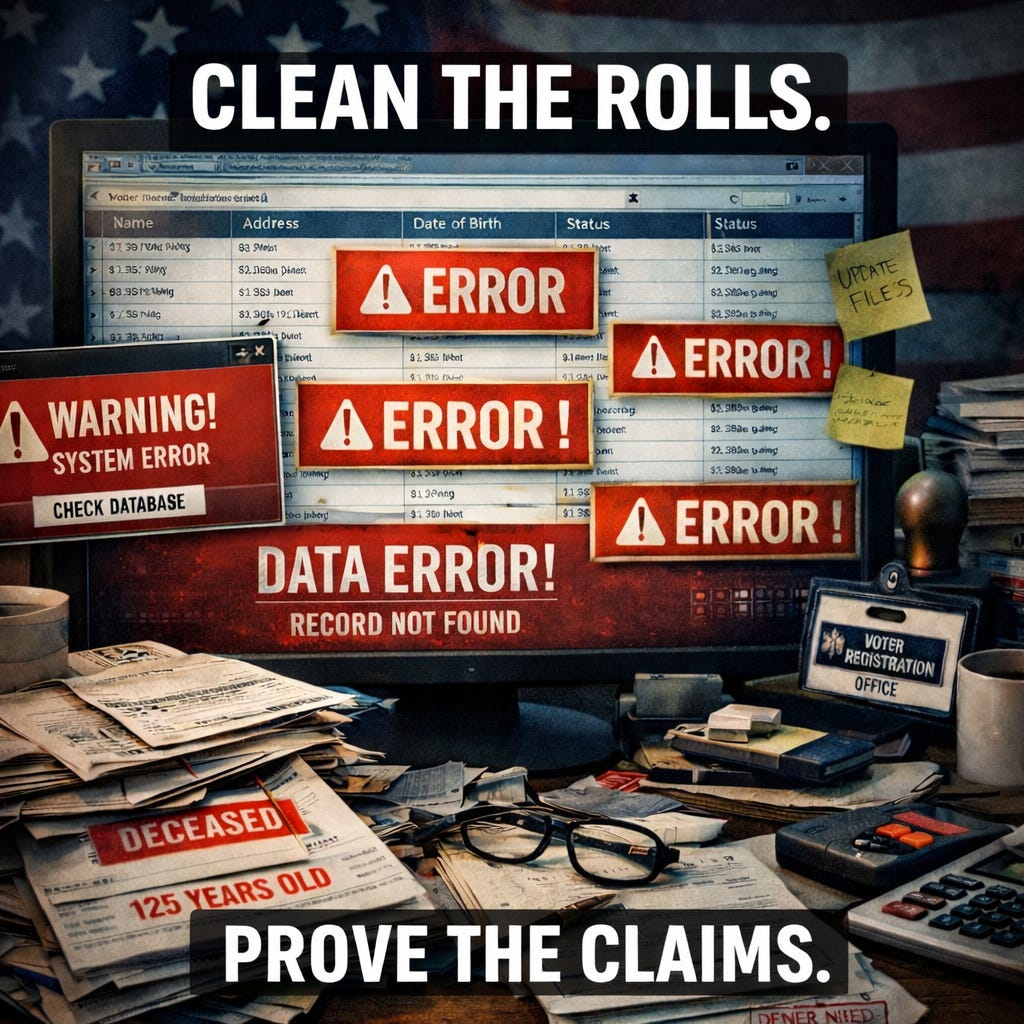
Dogs, Dead Voters, and the Only Debate That Actually Matters
Every few months California coughs up another headline that makes half the country grab a pitchfork.
125-year-old voters.
100 people registered at one address.
Ballots allegedly tied to deceased names.
Someone claiming they registered their dog.
And instantly we go from:
“This voter roll looks messy”
to “Democracy is dead and the Labradors are running Sacramento.”
By the way, this Phenomenon is prevalent in many, many states!
Slow down.
There are two very different arguments happening here, and people keep smashing them together because outrage is easier than thinking.
The Real Debate
Strip out the theatrics. What’s left?
A policy disagreement.
Republican argument:
Proof of citizenship plus voter ID equals common-sense guardrails. You need ID to board a plane, open a bank account, or pick up a prescription. Voting should not be the one sacred activity powered purely by trust and a signature that looks like an EKG reading.
Democratic argument:
ID requirements risk blocking eligible voters and are unnecessary because documented fraud rates are low. The bigger threat, in their view, is disenfranchisement, not impersonation.
That’s the fight.
Security versus access.
Risk versus friction.
Verification versus trust.
You can argue either side without claiming golden retrievers are swinging statewide elections.
The Cold Shower Nobody Likes
Every election system in America has flaws.
Red states.
Blue states.
Mail-heavy states.
Strict-ID states.
Human systems produce messy databases.
A 125-year-old registration is almost always:
a clerical error
a placeholder date
a lag in updating death records
or bureaucratic junk
It is not automatically proof that a Revolutionary War veteran just voted absentee.
Sloppy voter rolls are a management issue.
They are not, by themselves, proof of coordinated, outcome-changing fraud.
That leap — from “the database has errors” to “the election was illegitimate” — is a political jump. If someone is going to claim systemic fraud deciding elections, they need evidence at the scale of outcomes. Court-tested proof. Numbers large enough to move margins.
Viral anomalies are not the same thing as statistical proof.
What Actually Makes Sense
You can argue for:
Stronger voter ID laws
Proof of citizenship at registration
More aggressive voter roll maintenance
Expanded audits
Follow the actual laws of voting
Those are legitimate policy proposals.
You can also argue:
Fraud rates remain statistically low
Existing safeguards like signature verification and audits work
Overcorrection risks disenfranchising legitimate voters
Also legitimate positions.
What doesn’t work is skipping logical steps and declaring democratic collapse every time a spreadsheet looks embarrassing.
Clean voter rolls matter.
Public confidence matters.
But evidence matters more than adrenaline.
If you want to push voter ID, make the case clearly.
If you want cleaner rolls, demand better management.
Just don’t confuse database sloppiness with systemic fraud unless you can prove it at scale.
Because if democracy were truly being run by dogs, at least one of them would fetch the missing receipts and stop pretending the federal budget balances itself.
Yes, but... The issue is that the Democrats fight tooth and nail to prevent any cleanup of those "messy systems". The problem is that those "messy systems" are designed to prevent voting fraud from being detected, meaning that we really have no way to know how prevalent it is.
I've seen estimates that something on order of 10% of voters on the rolls in Democrat-run states are either dead or have moved out. And the Democrats often refuse to clean up those rolls until they are sued. Judicial Watch is doing a great job of forcing them to clean up their rolls.
Not requiring an ID to vote means that anyone can vote for anyone else. Think about that. Family members can vote for dead relatives. Heck, anyone can check to see who hasn't voted yet and vote in their place. What is to deter them? Is someone going to call the police and report them? Then what? Are the police going to ask for ID? Wait... they can't do that! So how can anyone get caught voting for someone else?
And even if someone got caught voting for someone else, the chances of getting prosecuted are small. What's one vote, after all? No big deal, right? It can't tip an election.
The unfortunate reality is that the Democrats have been cheating for decades, but there is no way to know the extent of it. For all we know, it could be 5% in every election. But the fact that they are fighting tooth and nail to keep the fraud going is telling.