
The Era of Managed War Is Over...
For the first time since World War II, an American president is not talking about managing a war. He is talking about ending one!

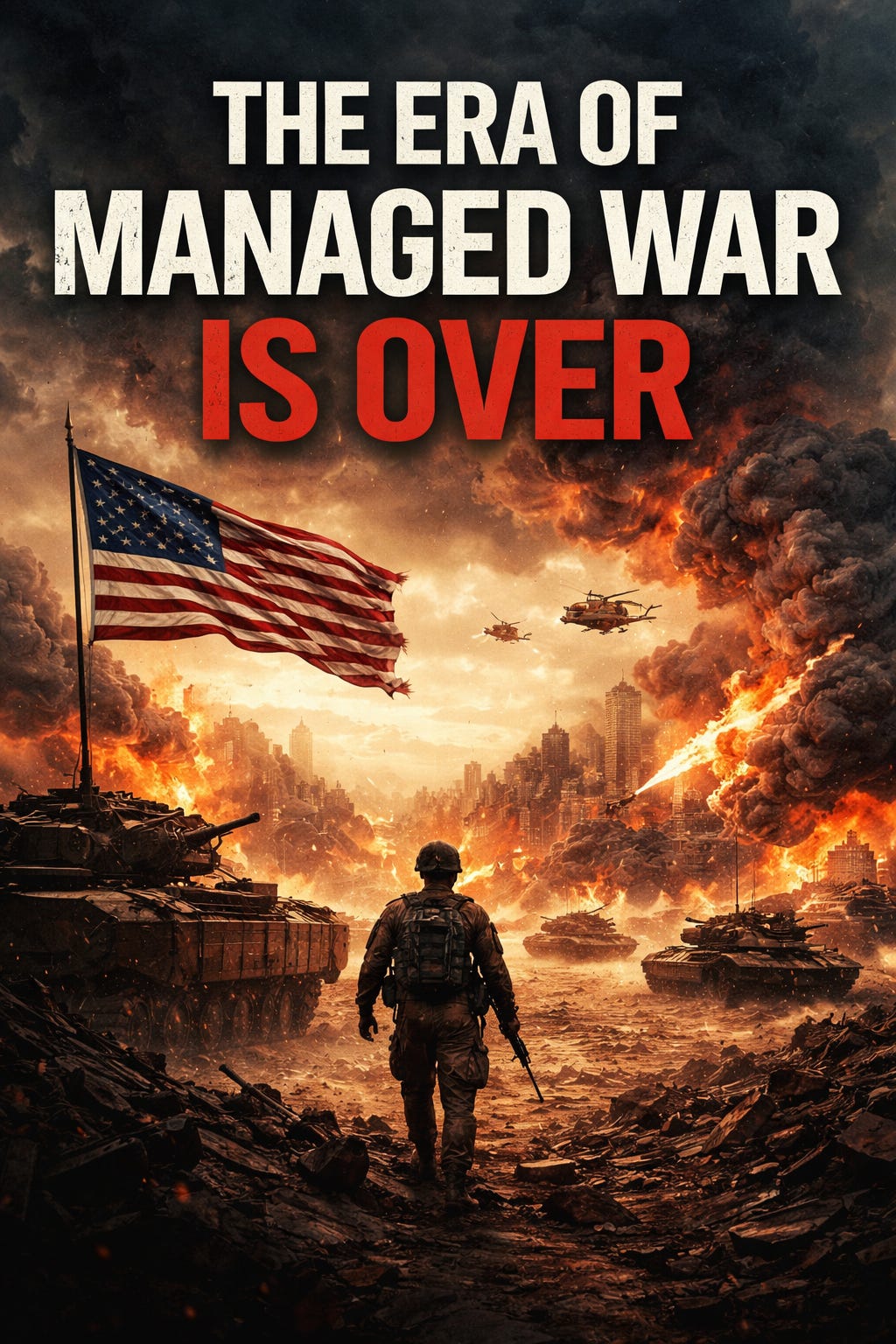
This is not about escalation.
It is about conclusion.
Something Shifted
Not bombs.
Not troops.
Not maps.
Language.
And language matters.
For eighty years after World War II, every American conflict came wrapped in careful wording.
Limited objectives.
Police actions.
Stabilization.
Peacekeeping.
Negotiated settlements.
We have not talked about victory like we meant it since 1945.
And now we are.
If this rhetoric holds, this is not a minor adjustment.
It is a philosophical break.
Management Versus Victory
For decades, the United States approached war like a nervous middle manager trying to calm down a chaotic office.
Calibrate the response.
Avoid escalation.
Signal restraint.
Offer an off ramp.
Whether you agreed with that strategy or not, it is fundamentally different from unconditional surrender doctrine.
The world notices that difference.
When Donald Trump says there will be no negotiated end, he is signaling something absent for generations.
The objective is not management.
It is resolution.
That does not mean chaos.
It means finality.
Big difference.
The Post 1945 Pattern
Let us stop pretending history is unclear.
The Korean War ended in an armistice.
The Vietnam War ended in withdrawal.
The Iraq War became a prolonged entanglement.
The War in Afghanistan ended in a twenty year fade out.
Not total capitulation.
Not decisive finish lines.
Not clear moral punctuation.
That pattern does something to a nation.
It shapes psychology.
People do not hate sacrifice.
They hate ambiguity.
Why Americans Grew Cynical
Here is the uncomfortable truth.
Americans are not afraid of war because they are weak.
They are exhausted because they watched ambiguous missions drain blood and treasure with no visible end state.
Clarity builds confidence.
Fog breeds resentment.
When objectives are vague, trust collapses.
When leaders speak in abstractions, people disengage.
That is not cowardice.
That is human nature.
Strength Is Not a Slogan
Now let me irritate both sides.
War is not a bumper sticker.
Decisiveness and destruction are not synonyms.
You can pursue decisive victory without abandoning morality, proportionality, or strategic planning.
Overwhelming force without a defined political end state is how you create the very quagmires people are furious about.
Strength without strategy is noise.
Strategy without strength is theater.
The Real Question
If this moment truly represents a shift, then here is what matters.
What does victory look like.
What does stability look like afterward.
What replaces the regime or ideology being confronted.
How do we prevent another forty seven year simmer.
Those are not talking points.
Those are the adult questions.
Rhetoric Versus Results
Yes, the language is different.
Yes, that alone signals a break from the post 1945 pattern.
But history does not judge adjectives.
It judges outcomes.
Rhetoric can change the mood of a nation overnight.
Results change the course of history.
And that is the difference.
Tell me I am wrong.
"STRENGTH IS NOT A SLOGAN" BRILLIANT PIECE! I BELIEVE ALOT OF FOLKS NEED TO READ THIS. GREAT STUDY DOWN THROUGH TIME!
I've spent half a century studying human violence, and I have to say that "managing" war is impossible, but the survivors can manage the message, which is why there's so many books about the same wars.