
The Long Game: What Happens After the Shooting Stops...
Winning the war is the easy part. Winning what comes after will decide the next twenty years!

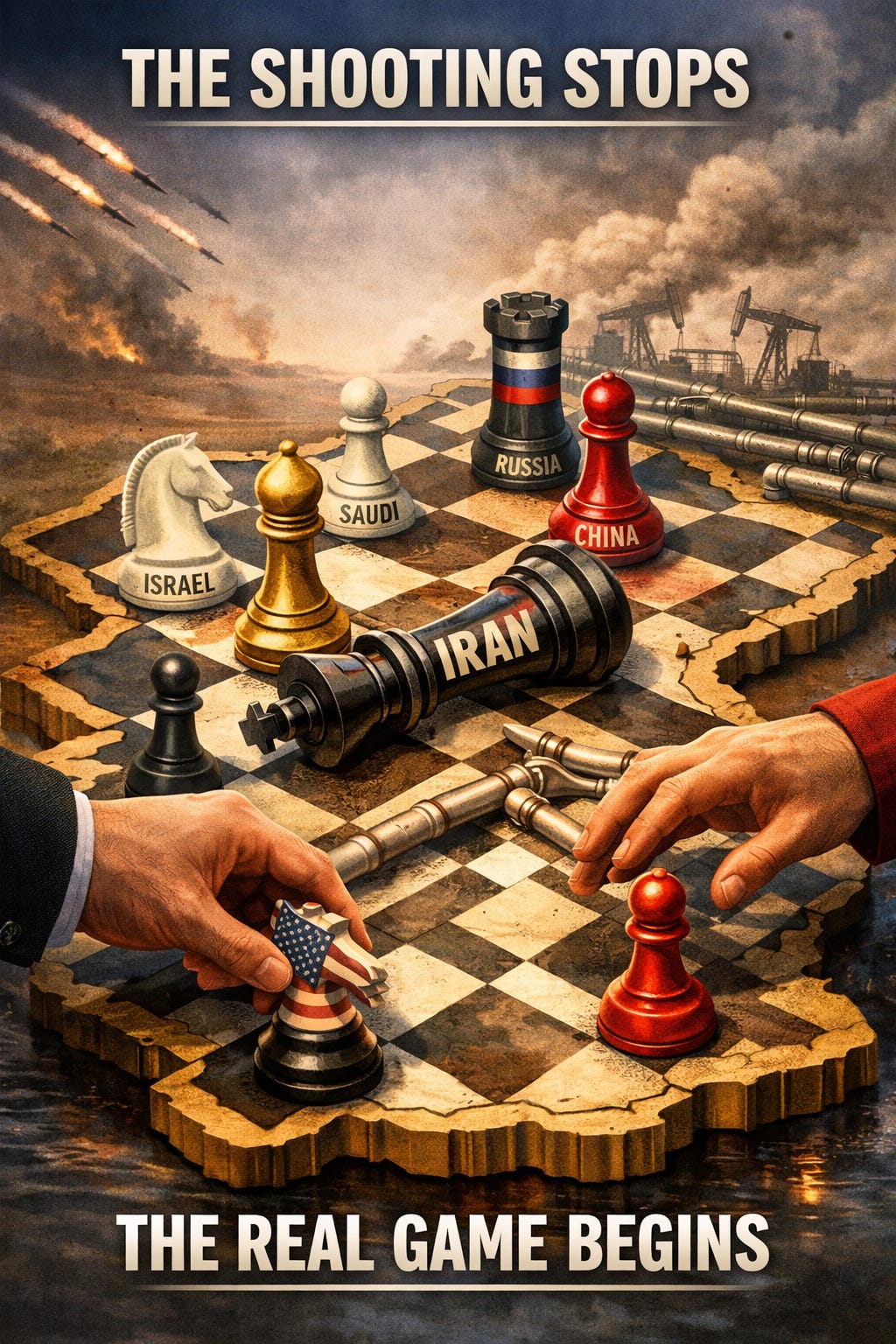
Everyone is arguing about the war.
That’s the wrong argument.
Because the war part is the easy part.
The hard part is what comes after the shooting stops.
And that’s where the real strategy begins.
Right now the conversation is still stuck on the fireworks.
Missiles.
Air strikes.
Escalation warnings.
Cable news loves that phase.
But history tells us something uncomfortable.
The explosions are just the opening act.
The part that actually reshapes the world happens after the guns fall silent.
The Power Vacuum Nobody Is Talking About
Authoritarian regimes look solid until the moment they crack.
Then suddenly the whole system starts fighting itself.
Iran isn’t a simple government structure. It’s a three-headed power system:
• The clerical leadership
• The Islamic Revolutionary Guard Corps (IRGC)
• The intelligence and security apparatus
As long as the regime is stable, those factions cooperate.
But if the system weakens, those factions begin doing what power structures have done for centuries.
They compete.
That competition can look like:
• elite infighting
• military commanders acting independently
• hardliners attempting to seize control
Which means Iran could enter a period of instability that lasts years, not months.
And unstable regimes don’t just affect themselves.
They affect entire regions.
The Proxy Network Problem
Iran doesn’t project power the way traditional countries do.
It runs a network of armed proxies.
Groups like:
• Hezbollah in Lebanon
• The Houthis in Yemen
• Shia militias across Iraq
• various armed groups operating in Syria
For decades these groups have relied on Tehran for funding, training, and strategic direction.
If the regime weakens, those networks don’t politely dissolve.
They start asking a simple question.
Who’s in charge now?
When proxy networks lose centralized control they often behave like independent actors.
Some escalate violence.
Some fracture.
Some turn inward.
Which means even if the main conflict cools down, the region could still experience years of aftershock instability.
The Real Battlefield Is Energy
Most people think this conflict is about missiles.
But the deeper strategic layer is energy.
Iran and Venezuela have both been major sanctioned oil suppliers to China.
China buys that oil because sanctions usually mean cheap prices.
If those supply chains are disrupted, the ripple effects are enormous.
China loses access to discounted energy.
Global oil markets shift.
U.S. and allied producers gain leverage over supply.
That might not sound dramatic.
But energy markets quietly shape global power more than speeches ever do.
Control the energy flow, and you influence the global economic system.
China and Russia Are Watching
The biggest players in this story are not actually Iran or Israel.
It’s China.
China’s long-term strategy depends on three things:
• stable energy imports
• expanding economic influence
• avoiding direct military confrontation with the United States
A weakened Iranian regime complicates that equation.
Russia also loses a strategic partner that helped counter Western pressure.
Neither Beijing nor Moscow is likely to react dramatically in the short term.
Instead they will do what major powers have always done.
Watch.
Wait.
And reposition.
Geopolitics moves slower than social media.
But the chessboard is already shifting.
A Possible Middle East Realignment
There is another possibility that could reshape the region entirely.
A weakened Iranian regime removes the central obstacle to broader Middle Eastern cooperation.
That opens the door for an expanded version of the Abraham Accords framework.
A regional bloc could emerge centered around:
• Israel
• Saudi Arabia
• the United Arab Emirates
• other Gulf states
If that alignment solidifies, it could form a security and economic coalition designed specifically to counter Iranian influence.
That would represent one of the largest geopolitical shifts in the region in decades.
But history rarely follows the cleanest scenario.
The Political Battle at Home
Back in the United States, the narrative fight will begin the moment the conflict cools.
If the region stabilizes and energy markets calm down, supporters will argue the operation restored American deterrence.
If instability spreads or oil prices spike, critics will argue the strategy was reckless escalation.
Same events.
Two completely different stories.
Politics isn’t really about facts.
It’s about which story wins.
History Dosn’t Care Who Was Right
Every war has two phases.
First come the explosions.
Then comes the rearranging of the world.
That second phase is where power actually shifts.
If Iran weakens, alliances shift.
If alliances shift, energy markets shift.
If energy markets shift, global power shifts.
And suddenly the question isn’t about one strike or one battle.
The question becomes something much bigger.
Did we just witness the beginning of a new Middle East?
Or the opening move in a much larger geopolitical struggle?
Because once the shooting stops, history doesn’t freeze.
It accelerates.
And twenty years from now, people won’t remember the headlines.
They’ll remember who ended up running the board.
I suspect Iran may be in for a protracted civil war/lack of central authority rather like Syria or Libya. That's good and bad for the world and region. good in that Iran will not be able to export terrorism or support proxies. Bad in that an unstable Iran could be a nexus for local instability that impacts global oil exports from the gulf
I don't expect the clerical establishment or current senior IRGC leaders to play any role in the future because I expect them to be dead. I expect the less religiously fanatical survivors to be getting out of town with as much loot as they can, which will mean that they too will play little role either.
I hope that someone (e.g. the shah) can establish a new central government that works but I'm not at all confident that this will happen.