
They Call It Criminal Justice Reform. You Might Call It Rolling the Dice...
What happens when rape and manslaughter no longer guarantee prison time?

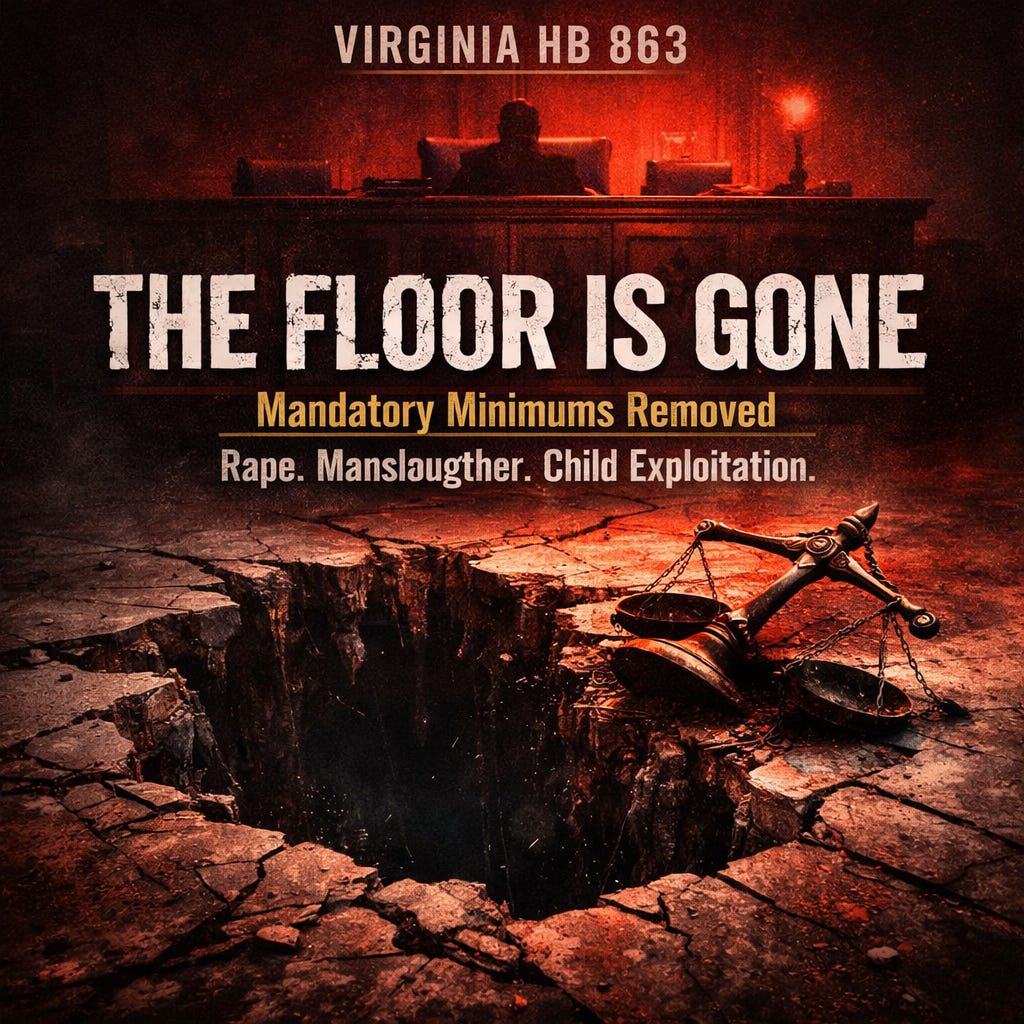
Virginia Just Decided Violent Crime Deserves a Softer Landing
When “reform” starts sounding like a clearance sale on consequences…
So let me get this straight.
The geniuses running Virginia looked at rape, manslaughter, and child pornography…
and said:
“You know what this system needs? Fewer mandatory minimums.”
That’s not satire. That’s House Bill 863.
This isn’t about parking tickets.
This isn’t about marijuana from 2009.
This isn’t about someone stealing a catalytic converter.
This is violent crime.
And Virginia Democrats are moving to eliminate many of the mandatory minimum prison sentences that used to act as the legal floor for some of the worst offenses on the books.
Not the ceiling.
The floor.
And once you remove the floor, gravity does what gravity does.
What Mandatory Minimums Actually Are
Before someone starts hyperventilating into a reusable grocery bag, let’s be clear.
Mandatory minimums are not “throw away the key forever” laws.
They are baseline consequences.
They say:
“If you commit X, the absolute minimum consequence is Y.”
That’s it.
It’s the legislature saying:
There is a line. Cross it, and you get at least this much time.
Predictable.
Uniform.
Clear.
Now?
It becomes:
“Depends on the judge.”
“Depends on the courtroom.”
“Depends on the mood.”
Same crime.
Different county.
Different outcome.
That’s not reform. That’s roulette.
Judicial Discretion Sounds Cute… Until It Isn’t
The talking point is simple.
“Judges need flexibility.”
Sure. Judges are human. Humans have judgment. That’s part of the job.
But judges also have ideology.
Some are tough.
Some are lenient.
Some think incarceration is society’s backbone.
Some think it’s a social construct invented by mean people in 1984.
When you eliminate mandatory minimums for violent crimes, you are not eliminating harsh sentences.
You are eliminating guaranteed consequences.
That’s a philosophical shift. A big one.
And it’s happening under the soothing label of “reform.”
Rape. Manslaughter. Child Exploitation.
Read those again.
We’re not debating jaywalking policy.
We’re debating whether the law should guarantee a baseline prison term for crimes that permanently shatter lives.
When lawmakers start loosening the guardrails on violent offenses, you don’t need hyperbole.
The stakes are already sky-high.
Law enforcement groups have warned that eliminating mandatory minimums weakens accountability. Prosecutors worry about losing leverage in plea negotiations. Victims’ advocates question whether deterrence gets diluted.
That’s not fringe paranoia. That’s institutional concern.
But apparently the new vibe in Richmond is:
“Let’s see how this goes.”
Fantastic.
What Did Voters Think They Were Getting?
This is the part nobody likes to say out loud.
Elections have downstream effects.
When you hand unified power to one party, you are not just voting for campaign ads. You’re voting for policy architecture.
Did suburban voters in Virginia think they were signing up for reduced statutory minimums on violent crimes?
Maybe they did.
Maybe they didn’t read that far down the fine print.
But this is the product.
You don’t get to say “I just wanted competent schools and potholes fixed” and then pretend criminal justice philosophy isn’t part of the package.
It is.
Always has been.
The Broader Pattern
This isn’t isolated.
Across blue jurisdictions, there’s a steady drift toward softening structural consequences in the name of reform.
Mandatory minimums? Too rigid.
Cash bail? Too unfair.
Sentencing enhancements? Too harsh.
The theory is always compassionate.
The question is always the same:
At what point does compassion for the offender begin to eclipse protection for the victim?
That’s not a rhetorical flourish. That’s the heart of the debate.
The Real Risk
When laws become unpredictable, public confidence erodes.
When consequences feel inconsistent, deterrence weakens.
And when violent crime policy starts tilting toward discretion over certainty, ordinary people start asking a very simple question:
Who exactly is this system built to protect?
You can believe in reform.
You can debate incarceration rates.
You can argue about fairness.
But when you start loosening the floor on crimes like rape and manslaughter, you are making a statement about priorities.
And voters deserve to understand exactly what that statement is.
Virginia wanted a new direction.
It’s getting one.
Let’s just hope the people who pay the price aren’t the ones who never asked for this experiment in the first place.
Communism on parade.