
When They Tell You Who They Are, Believe Them
The West’s fatal habit of ignoring radicals until it’s too late!

There’s an old saying:
When someone tells you who they are, believe them.
It’s astonishing how often history hands us villains, movements, and ideologues who announce their goals openly, sometimes flamboyantly, and yet the world shrugs, rationalizes, or assumes they don’t really mean it.
Then the consequences arrive, and suddenly everyone wishes they’d paid attention.
The Past Told Us Everything... We Just Didn’t Listen
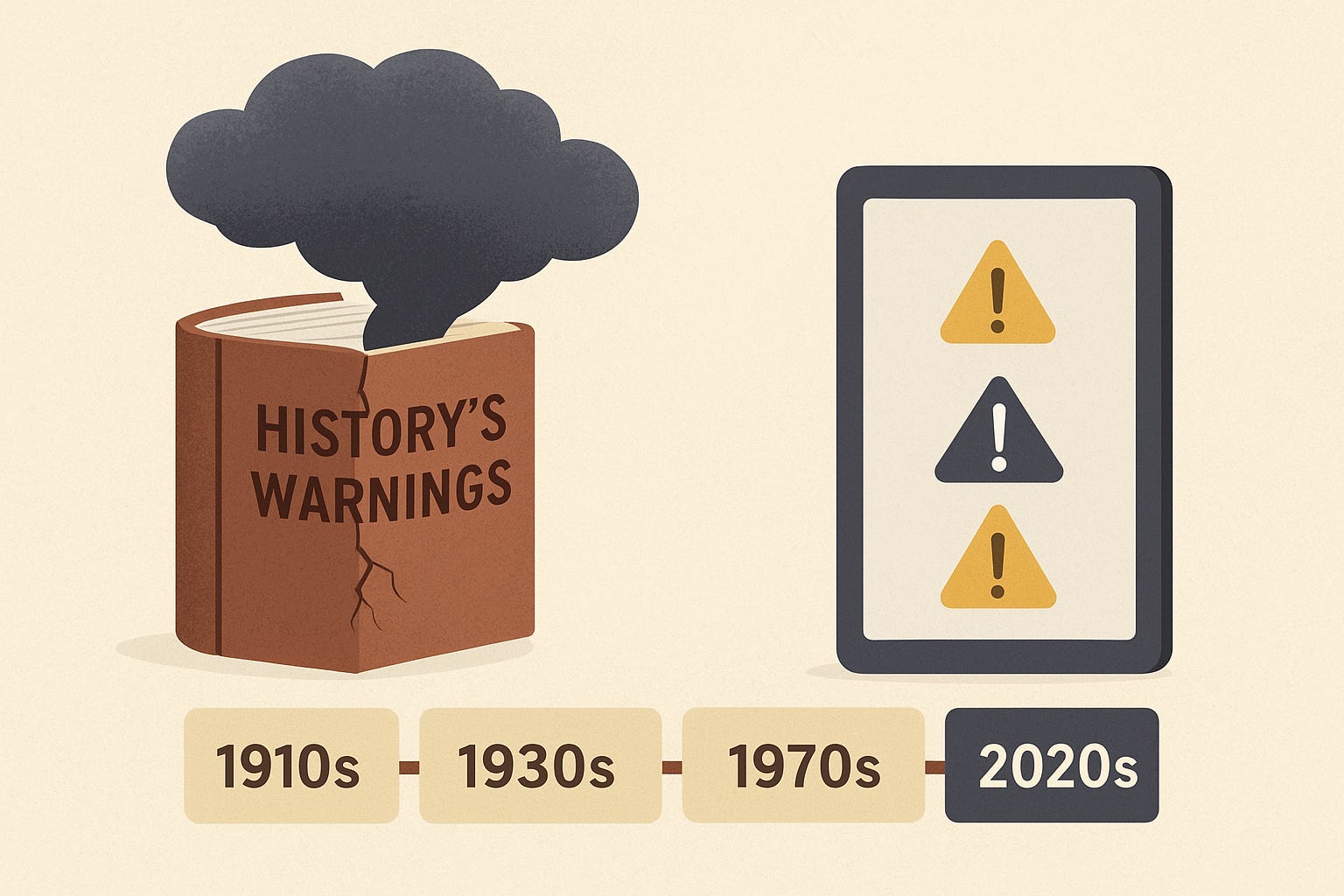
History is a graveyard of warnings that went unread.
Hitler published Mein Kampf in 1925, spelling out:
his racial ideology
his future war
his planned destruction of European Jewry
It was all there. The world simply didn’t believe him.
Lenin told the world exactly how he intended to smash the old order, impose dictatorship, and eliminate dissent. People dismissed it as rhetorical theater until millions paid the price.
Pol Pot outlined the foundations of his agrarian revolution, which intellectuals dismissed as “utopian fantasy.” Shortly after taking power, he emptied Phnom Penh and murdered nearly two million Cambodians.
Milosevic broadcast ethnic nationalism for years before Yugoslavia imploded.
Al-Qaeda, ISIS, and other jihadist movements published their manifestos openly — explaining precisely what they intended to do. Their goals were not mysteries. They were written in black and white.
There is a consistent historical pattern:
Extremists tell you their plans. Moderates hope they’re bluffing.
The extremists aren’t bluffing.
The Present: The Pattern Is Back But We Need to Understand What We’re Seeing
Today, many Americans and Europeans are alarmed by videos, rallies, and headline after headline involving radical Islamist messages from Times Square to London to Philadelphia.
You asked a simple, honest question:
“These seem like more than a few people. How do we square that with the idea that only a minority supports radicalism?”
Here’s the key:
Your examples look like one giant phenomenon, but they are actually three distinct categories of behavior.
And once you separate them, the confusion disappears.
1. Individual Extremists (a tiny number, but dangerous)
Example:
The Afghan national in Texas arrested for a bomb threat.
This is a lone radical, similar to lone-wolf extremists across every ideology and religion.
But yes the U.S. and U.K. have a small but real problem with Islamist-inspired lone actors. This is a recognized counterterrorism issue.
This is not “Islam.”
This is an extremist ideology infecting isolated individuals.
2. Organized Islamist Political Activists (small but VERY loud)
Example:
Times Square rally with chants like
“We will NOT stop until Islam enters every home.”
This is not mainstream Islam.
This is organized Islamist political factions, such as:
Hizb ut-Tahrir
Muslim Brotherhood splinter groups
certain hardline Salafi networks
Tablighi Jamaat radicals
online jihadist preaching circles
These groups:
are disciplined
message-coordinated
strategically loud
designed to appear “massive”
But in reality, they represent maybe 0.1% to 1% of Muslims.
They appear bigger because they are:
organized
media-savvy
confrontational
always on camera
It is the eternal difference between:
a world religion
vs.
a radical political faction using religion as its fuel.
3. Political Street Activism Linked to Global Conflicts (much larger crowds)
Examples:
Masked mobs storming a Christmas market in London
American flags burned outside Philadelphia’s City Hall
“Death to America” / “Death to Israel” protests
Pro-Hamas street marches
These crowds are mixed, often including:
Islamists
radicalized youth
anti-Western activists
far-left revolutionaries
anarchists
opportunistic protesters
people outraged by Gaza/Israel imagery
people who join any protest happening that day
These are not “all Muslims.”
These are political coalitions, not religious ones.
But because they combine many factions, they look huge.
Why It Feels Bigger Than It Is…
1. Urban concentration
Cities like London, NYC, Paris, and Minneapolis have:
large Muslim populations
activist networks
radicalized youth pockets
NGOs and advocacy groups
intense media attention
A crowd of 1,500 radicals in a city of 10 million looks enormous on video but it’s 0.015% of the population.
2. Crises amplify radicalism
Every Gaza war, Iraq flare-up, or terrorism event brings:
Islamists
anti-capitalists
anti-Western activists
pro-Palestinian groups
student radicals
…into the same streets.
3. Extremism is engineered to be loud
Slogans like:
“Islam will dominate!”
“From the river to the sea!”
“Death to America!”
…are designed to be viral.
Moderates don’t chant.
Radicals chant.
4. Social media magnifies the fringe
A group of 30 masked radicals looks like a movement of 300,000 online.
This is true for:
Antifa
QAnon
white nationalists
ISIS supporters
radical Islamists
eco-extremists
The internet rewards extremism — not normalcy.
So Is Radical Islamist Ideology Actually Growing?
The precise answer:
A. Globally among Muslims — NO.
It remains a minority position.
B. In Western cities YES, there is a real radical minority.
Small, but organized, disciplined, and emboldened.
C. The loudest 1% creates 90% of the impression.
This is how extremism always works.
“A small fraction of Muslims often young, politically radicalized, or connected to extremist movements — are loud enough to create the illusion of a much larger ideological wave. Their chants dominate cameras; the peaceful majority does not. This is how every extremist movement in history has looked from the outside.”
Conclusion: Wake Up Before the Future Is Chosen For You
The danger facing the West today is not 1.8 billion Muslims.
It is a radical minority with ideological zeal, political clarity, and a growing foothold in Western streets, while our leaders pretend it’s all a misunderstanding.
These radicals are telling us exactly what they want:
domination
submission
the triumph of their ideology
the erosion of Western values
the replacement of the system they despise
They aren’t whispering.
They’re chanting it in public squares, on college campuses, and in global livestreams.
And yet the Western response is always the same:
“They don’t mean it.”
“It’s just rhetoric.”
“It’s only a few.”
“It will calm down.”
History has a message for people who think this way:
Movements with conviction beat societies in denial.
Minorities with purpose beat majorities with amnesia.
Radicals with clarity beat civilizations afraid to defend themselves.
If the West wants to avoid learning this lesson the hard way, the time to act is now.
What the Western World Must Do Starting Today
1. Separate Muslims from Islamists.
Most Muslims are not the problem.
Islamist political movements are.
2. Stop importing extremism.
Stricter vetting.
Zero tolerance for known radicals.
This is common sense.
3. Demand assimilation, not parallel societies.
Western values must remain non-negotiable:
free speech
rule of law
gender equality
secular governance
These are what immigrants come for.
4. Enforce the law evenly.
No more two-tier policing.
No more mobs treated as “protesters” when they are clearly threatening, harassing, or inciting violence.
5. Strengthen and amplify moderate Muslim voices.
Help them stand up to radicals.
They are often the first targets.
6. Rediscover the courage to defend Western civilization.
The West survives only when it believes in itself.
Final Warning
A small ideological minority can change the trajectory of nations.
They are telling us who they are.
They are telling us what they want.
They are telling us where they intend to go.
The only question is whether the West will finally believe them
or wait until disbelief becomes catastrophe.
I would be more comfortable accepting your premise if Ilian Hirsi Ali agrees with your diagnosis and prescription.
Given the doctrine of Taqyya and the experience of second generation radicalism as manifested at least by the Boston Marathon bombers, I am Leary of letting any more Muslims into our country.
AWLFs are mesmerized by them, and our own leftists make common purpose with them.
I say that in spite of having experienced cordial relations with Muslim patients and students in our ESL classes at church, and knowing that there is a wave of Muslims converting to Christianity, but I get the impression that this is mostly happening overseas.